
Our American Revolutionary War is remembered by its heroes and participants: George Washington, Betsy
Ross, Benjamin Franklin, Von Steuben, Lafayette, Thomas Jefferson, William Knox. We also remember places where our fight for
independence occurred: Bunker Hill, Saratoga, Trenton, Princeton, Yorktown, and Valley Forge. But who mentions the little known
and too often forgotten Fishkill Supply Depot and Encampment where material and supplies to keep the Continental troops fighting;
were built, collected and distributed, where British soldiers were imprisoned and Americans received hospital care, where
Revolutionary War soldiers served and over 300 were buried in unmarked graves.
WE REMEMBER! Introducing the Fishkill Supply Depot
- little know, long forgotten, yet remains:
"America’s Last Great Revolutionary War site."
Declared as "the last of the important Revolutionary War sites yet to be properly explored," the Fishkill Supply Depot remains so today: a one-of-a-kind site of national importance that has never gotten its due. Located in Fishkill, New York, the Depot was a key strategic center of the American Revolution, established and visited repeatedly by George Washington. Known as the "Military nerve center of the Continental army," the Depot was one of three major encampments along with Morristown and Valley Forge. Hallowed history happened here - hundreds of the original soldiers who fought to found our nation died and were buried in unmarked graves.
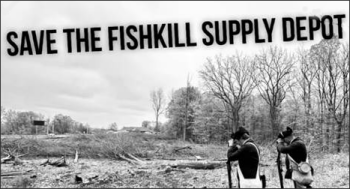
Central to the outcome of key battles like Saratoga, the Depot played an important role in the founding of the United States, and its significance in American history cannot be overemphasized. Yet today, the National Register Fishkill Supply Depot is under threat of commericial development. A large part of the historic site was covered by the Dutchess Mall in the early 1970s. This is where the barracks and parade grounds were located. Crossroads digging In May 2013, earth-moving equipment is brought on-site at Crossroads to clear land for development while wreaths from our annual WAA event in December still stand proud marking the graves of Fishkill Revolutionary War soldiers.
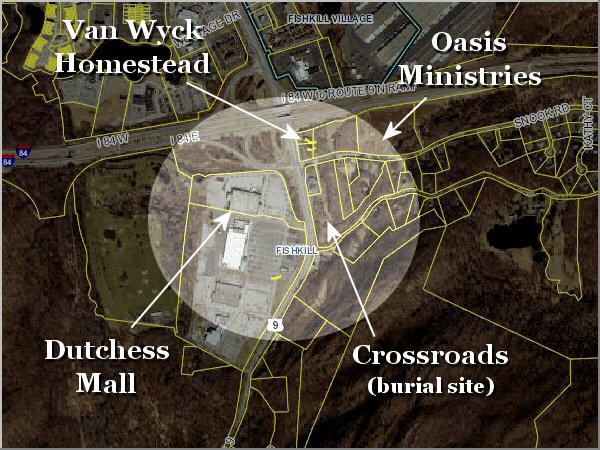 Modern-day aerial-view of the Fishkill Supply Depot (75 acres along Route 9 in Fishkill NY)
Time is running out for preserving a priceless heritage, a key historic and archaeological site in the town of Fishkill, dating from the American Revolution. The site, the Fishkill Supply Depot, has been listed for decades in the National Register of Historic Places and consists of more than 70 acres on the East and West sides of southern Route 9. Here more than two centuries ago, thousands of Continental Army soldiers weathered the winters of 1776 to 1783 and blocked the British strategy of advancing unopposed up both sides of the Hudson to secure a line of communication from New York City to Canada. If the patriot forces had failed in this effort, it could have spelled defeat for the patriots and assured the ultimate victory of the Royalist cause in North America.
 At its peak, the encampment, built under orders from General George Washington was a small city which included extensive barracks
and officer huts for thousands of soldiers, guard house and palisade, a prison, major hospital, artillery placements, storage
buildings, an armory, blacksmith shops, stables, parade grounds, and a powder magazine which supplied all Northern Patriot forces.
Today, the only remaining structure is the Van Wyck Homestead, originally a farmhouse which served as a headquarters for military
operations.
At its peak, the encampment, built under orders from General George Washington was a small city which included extensive barracks
and officer huts for thousands of soldiers, guard house and palisade, a prison, major hospital, artillery placements, storage
buildings, an armory, blacksmith shops, stables, parade grounds, and a powder magazine which supplied all Northern Patriot forces.
Today, the only remaining structure is the Van Wyck Homestead, originally a farmhouse which served as a headquarters for military
operations.
Reflecting the site's importance, the Fishkill Supply Depot and Encampment was placed on the "National Register for Historic Places" in 1974. But subsequently plans to make the Depot a national park and open it up to serious archaeological investigation were thwarted. Now, once more, land belonging to the encampment and supply depot, which has never been properly assessed by experts in the field of military archaeology, is being seriously threatened by a new round of commercial development on land east of the highway. As a result, the archaeological and historical record of what remains of the encampment will be further jeopardized, depriving future generations of a direct link to a remarkable past.
At its peak, the encampment, built under orders from General George Washington was a small city which included extensive barracks and officer huts for thousands of soldiers, guard house and palisade, a prison, major hospital, artillery placements, storage buildings, an armory, blacksmith shops, stables, parade grounds, and a powder magazine which supplied all Northern Patriot forces. Today, the only remaining structure is the Van Wyck Homestead, originally a farmhouse which served as a headquarters for military operations.
Reflecting the site's importance, the Fishkill Supply Depot and Encampment was placed on the "National Register for Historic Places" in 1974. But subsequently plans to make the Depot a national park and open it up to serious archaeological investigation were thwarted. Now, once more, land belonging to the encampment and supply depot, which has never been properly assessed by experts in the field of military archaeology, is being seriously threatened by a new round of commercial development on land east of the highway. As a result, the archaeological and historical record of what remains of the encampment will be further jeopardized, depriving future generations of a direct link to a remarkable past.
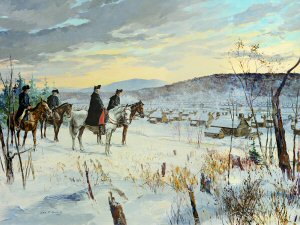 "The Last Cantonment 1783" by Hudson Valley artist John F. Gould is a good depiction
of what the depot would have looked like in 1777.
"The Last Cantonment 1783" by Hudson Valley artist John F. Gould is a good depiction
of what the depot would have looked like in 1777.
★ Hold off further disturbance and development of the properties within the 70 acre Fishkill Supply Depot site.
★ Seek the support of the most suitable entity, whether it be a private organization, the town, state or federal government, to purchase properties within the Depot site which are under the imminent threat of development.
★ Pursue assistance to develop an appropriate plan to preserve, restore and maintain the Depot as a Revolutionary War site that is central to all other recognized Revolutionary War sites within the Town of Fishkill as well as Dutchess County.
Visit the 1700's at the Van Wyck Homestead which served as headquarters of the historic Fishkill Supply Depot.
Postcard (circa 1905) showing the original placement of the D.A.R. Monument. It now rests at the Van Wyck Homestead.
Located within the National Register Fishkill Supply Depot this stone wall may hold secrets from the past.